




After exploring Pressure Die Casting in our previous article, it’s time to discuss another fascinating and widely used metal casting method — Centrifugal Casting.
This technique is known for producing dense, high-quality components, especially those with cylindrical or symmetrical shapes such as pipes and bushings. Let’s take a closer look at how it works and why it’s so effective.
What Is Centrifugal Casting?
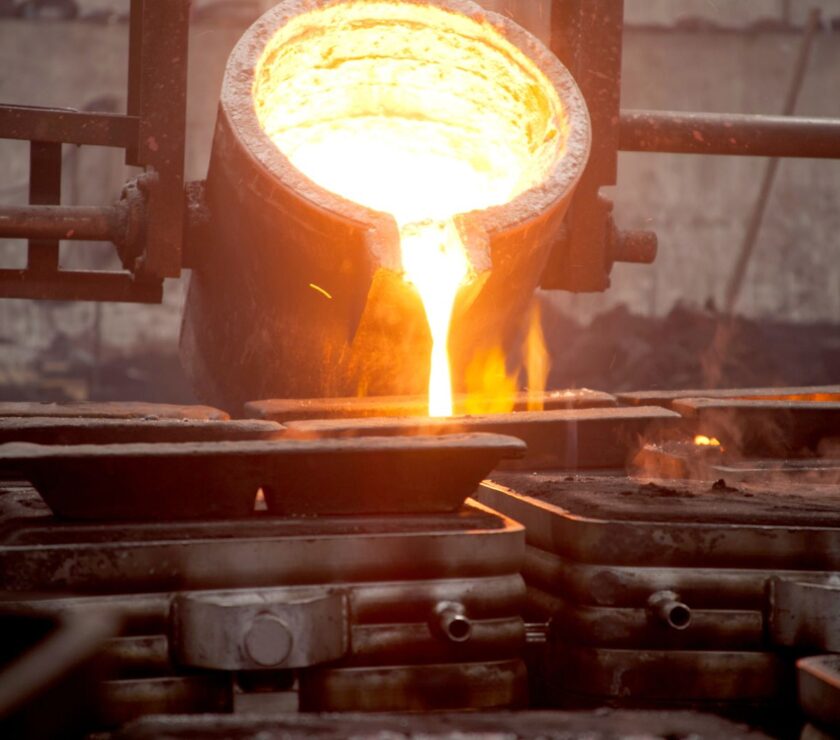
Centrifugal casting is a casting process in which molten metal is poured into a rotating mold. The rotation generates centrifugal force, pushing the molten metal outward toward the walls of the mold.
This process can be performed using vertical or horizontal molds, depending on the shape and design of the final product. The direction of rotation relative to the flow of molten metal also affects the properties of the final casting.
Typically, metal molds (permanent molds) are used in this process instead of sand molds, allowing for greater precision, smoother surfaces, and reusable tooling.
How the Process Works
When molten metal is poured into a rapidly spinning mold, the centrifugal force distributes the metal evenly along the mold walls.
The force also accelerates heat dissipation, causing the metal to solidify quickly and form a dense, high-strength structure, particularly along the outer surface.
This results in castings that are durable, free of air pockets, and suitable for heavy-duty industrial use.
Types of Centrifugal Casting
Centrifugal casting can be divided into three main types, each designed for different kinds of products:
1. True Centrifugal Casting
This method is primarily used to produce tubular or cylindrical parts such as pipes, bushings, and sleeves.
In this process, molten metal is poured into a rotating mold (either horizontally or vertically). The rotation begins at a low speed, then increases until the molten metal spreads uniformly across the mold walls. The mold continues spinning until the metal solidifies completely.
Key characteristics of true centrifugal casting:
- Produces high-density castings, especially on the outer surface.
- Reduces shrinkage defects due to the continuous centrifugal pressure.
- Slag and impurities collect on the inner surface, which can be easily removed through machining.
2. Semi-Centrifugal Casting
The semi-centrifugal method is used for solid castings with radial symmetry, such as automotive wheels, pulleys, and brake drums.
The process starts with the mold at rest. Once molten metal fills the cavity, the mold is rotated at a controlled speed while solidification occurs. The centrifugal force ensures the molten metal fills every part of the cavity evenly.
This technique is ideal for medium-sized parts (around 100 mm in length). The outer section of the casting becomes denser than the center, which can be machined easily if a central hole is required.
3. Centrifuge Casting
Unlike the previous two methods, centrifuge casting is used to make small, complex parts that do not require radial symmetry.
In this process, the mold cavities are placed away from the center of rotation. As the mold spins, the molten metal is distributed into multiple cavities using centrifugal force. The rotation continues until the metal solidifies.
This method is efficient for mass-producing small precision components, such as gears, bushings, or small industrial fittings.
Advantages of Centrifugal Casting
Centrifugal casting is popular across industries because it offers a range of benefits:
- High density and strength in finished products
- Reduced porosity and minimal casting defects
- Smooth surface finish, reducing the need for extensive machining
- High material efficiency, thanks to reusable metal molds
Because of these advantages, centrifugal casting is widely used in automotive, piping, mechanical, and electrical industries.
Conclusion
Centrifugal Casting is a powerful casting technique that harnesses the force of rotation to produce strong, dense, and precise metal parts.
Whether it’s true centrifugal, semi-centrifugal, or centrifuge casting, each method offers unique advantages suited to specific product types and industrial needs.
With its combination of efficiency, quality, and durability, centrifugal casting continues to be one of the most reliable technologies in modern metal manufacturing.