


In the modern metal casting industry, various methods have been developed to produce high-quality components with complex shapes. One of the most efficient and environmentally friendly methods today is Lost Foam Casting — an innovative process that combines precision, flexibility, and cost-effectiveness.
What Is Lost Foam Casting?
Lost Foam Casting is a casting method that uses expanded polystyrene (EPS), commonly known as styrofoam, as a pattern material. The foam pattern is buried in dry silica sand without any binding agent, then compacted using vibration to form a solid mold.
It’s called “lost foam” because when molten metal is poured into the mold, the foam pattern evaporates and disappears, leaving a cavity that is immediately filled by the liquid metal. Once the metal solidifies, the final casting replicates the exact shape of the foam pattern.
Step-by-Step Process of Lost Foam Casting

Here are the main stages of the Lost Foam Casting process:
1. Pattern Making Using EPS
The pattern is made from expanded polystyrene (EPS), shaped according to the design of the final product. This can be done by carving foam blocks or molding polystyrene beads in a metal mold, which are then heated with steam to fuse into a solid pattern.
2. Creating the Gating System
Next, a gating system (including the sprue and runner) is also made from foam material. Once all parts are complete, they are assembled together into a cluster, often called a pattern tree.
3. Coating the Pattern with Ceramic Material
The assembled foam pattern is then coated with a ceramic slurry, usually made from fine refractory powder mixed with a binder such as colloidal silica.
This coating helps produce a smoother surface finish and prevents sand from entering the molten metal cavity during pouring. The coating process may be done several times, but an overly thick layer can trap gases and cause casting defects.
4. Placing the Pattern into the Mold
Once coated and dried, the foam pattern is placed into a molding flask and covered with unbonded silica sand. The sand is compacted using a vibration system to ensure stability and support during pouring.
5. Pouring Molten Metal
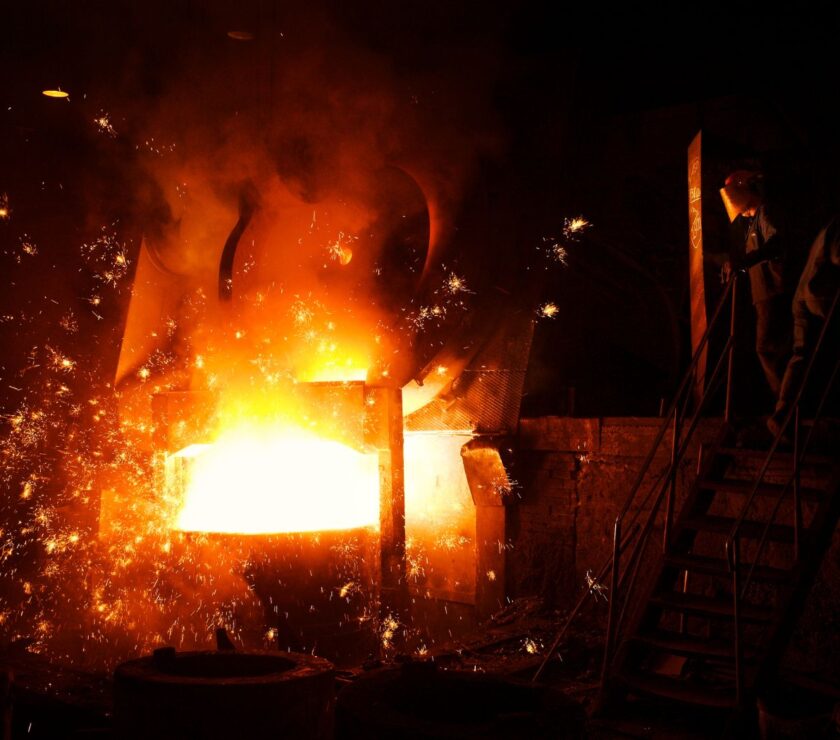
When the mold is ready, molten metal is poured into the sprue. The foam pattern burns and evaporates, while the metal flows into the space it leaves behind, filling it completely until it solidifies.
6. Shakeout Process
After solidification, the mold is turned over to remove the sand. Because no binders are used, the sand separates easily and can be reused directly in the next casting cycle.
Advantages of Lost Foam Casting
This casting method is widely used for aluminum and non-ferrous alloys due to its many advantages, such as:
- High design flexibility – ideal for complex shapes.
- No parting line – since the foam pattern is molded directly in sand.
- No need for cores in many cases.
- Reduced labor and production costs.
- Inexpensive and easy-to-make patterns.
- Environmentally friendly – no binders are used, and sand can be reused.
- Excellent dimensional accuracy – provides a smooth surface finish and precise details compared to conventional sand casting.
Disadvantages of Lost Foam Casting
Despite its many benefits, the process also comes with a few challenges:
- Higher porosity risk, as gas from the burning foam may become trapped if the pattern doesn’t burn completely.
- Requires careful coating and sand compaction to ensure consistent casting quality.
Conclusion
Lost Foam Casting is a modern casting technology that delivers high-quality results efficiently and sustainably. With precise control throughout each stage — from pattern making to molten metal pouring — this process can produce strong, accurate, and environmentally friendly metal components.